7 Ways to Make Patient Waiting Experiences More Predictable
A better waiting experience does not necessarily mean eliminating every delay. It means helping patients understand what is happening, giving them appropriate information and choices, and making the service process easier to navigate.

Patients may understand that medical visits take time. What frustrates them is not knowing how long they will wait, what happens next, or whether anyone has noticed that they are still waiting.
Imagine a patient arriving at your clinic for a scheduled consultation. They check in at reception and take a seat. Thirty minutes pass. Then another thirty. More patients arrive, the waiting area becomes crowded, and some people who arrived later appear to be called first. The patient approaches reception to ask how much longer they will wait, but the team cannot provide a reliable answer.
Perhaps the doctor is attending to a patient who needs additional care. Perhaps registration is taking longer than expected. Or perhaps several appointments were scheduled too close together.
Whatever the reason, the patient is left with the same question: How much longer will I have to wait?
For the patient experience manager or hospital administrator, this situation may seem like a routine operational challenge. But when it repeats across dozens or hundreds of visits, unpredictable waiting can become a major service delivery concern. It can generate complaints, place additional pressure on frontline teams, disrupt patients' daily responsibilities, and influence how people perceive the facility.
The good news is that improving the waiting experience does not necessarily begin with hiring more staff or undertaking a major operational overhaul.
It begins with understanding why patients wait, identifying where uncertainty enters the service journey, and making deliberate improvements to how queues and appointments are managed.
Here are seven practical ways to get started.
1. Recognise That the Waiting Experience Begins Before the Consultation
Consider two patients who each wait for 45 minutes.
The first receives an explanation of the expected waiting time, is informed when the schedule changes, and understands what to do next.
The second receives no updates, repeatedly asks reception for information, and has no idea whether their appointment is approaching. Although both patients wait the same amount of time, their experiences may differ greatly.
This illustrates an important distinction: reducing waiting time and improving the waiting experience are related, but not the same.
What your facility can do.
Map the patient journey from appointment booking to consultation. At each stage, ask:
- Does the patient know where to go?
- Do they understand the registration process?
- Are they told what to expect after checking in?
- Can they find out whether their appointment is running late?
- Do they know how they will be notified when it is their turn?
These questions can reveal opportunities to improve communication without necessarily changing the clinical service itself.
The takeaway: A more predictable patient experience starts with making the process easier to understand.
2. Communicate Expected Waiting Times. Keep Patients Updated
Patients may accept that consultations take time. What makes the experience difficult is the lack of information to help them plan. A patient who expects to wait 20 minutes but waits for an hour without an explanation may feel ignored. A patient who receives an honest update about a delay may be better able to manage their expectations.
What your facility can do.
First, establish a clear communication process. Decide who is responsible for updating patients when appointments fall behind schedule.
Second, provide realistic estimates where possible. If your facility has reliable historical data, use it to understand typical waiting periods and develop reasonable estimates. Make it clear that these are estimates, not guarantees.
Third, explain changes. When delays occur, communicate them as early as practical rather than waiting for patients to ask.
Fourth, offer a convenient way to check queue status.
Depending on your facility's needs, this could involve reception enquiries, a digital display, SMS notifications, WhatsApp messages, or a queue management system that provides position and estimated waiting-time information.
The takeaway: When you cannot eliminate uncertainty, better communication can help reduce it.
3. Review How Appointments and Walk-In Patients Are Managed
Many healthcare facilities serve a combination of scheduled appointments and walk-in patients.
Without clear processes, the resulting queue can appear confusing or unfair. Patients may not understand why someone who arrived later was attended to first. Reception staff may struggle to explain what is happening, particularly when several departments use different procedures.
What your facility can do
Start by reviewing your current appointment and queue management processes. Consider these questions:
- Are appointment slots realistic given the typical duration of consultations?
- How are late arrivals handled?
- How are walk-in patients accommodated?
- What happens when a doctor falls behind schedule?
- How are emergency and other priority cases handled?
- Do different departments follow consistent, clearly communicated procedures?
Look for recurring patterns rather than assuming every delay is an isolated incident.
For example, if a clinic consistently experiences long waits between 9:00 a.m. and 11:00 a.m., examine whether appointment scheduling, staffing, registration, or demand is contributing to the problem. Where appropriate, consider whether a more coordinated system for managing scheduled appointments and live queues would help.
Digital appointment and queue management tools can support this process, but the underlying workflow must still reflect the facility's clinical and operational requirements.
The takeaway: Better queue management begins with understanding how patients enter, move through, and leave your service environment.
4. Give Patients More Flexibility in How They Wait
Traditionally, patients have often been expected to remain in a designated waiting area until their names are called.
Consider a patient attending a routine outpatient appointment. If they could retain their place in the queue, monitor their progress, and receive an alert when they need to return, they might have greater flexibility in how they spend their waiting time.
This could be particularly useful where waiting areas are congested, or patients need to manage other responsibilities.
However, remote queueing is not suitable for every situation. Patients awaiting urgent assessment or services requiring immediate monitoring must follow the facility's clinical instructions.
What your facility can do
Assess which services could safely support more flexible waiting arrangements.
For suitable services, consider whether patients could:
- Join an eligible queue remotely.
- Check their queue position without returning to reception.
- Receive a message when their turn approaches.
- Use a digital queue ticket rather than relying entirely on a physical line.
- Retain access to an in-person check-in option if they prefer it.
A modern virtual queue management system can support these arrangements, depending on its capabilities and configuration.
The important question is not whether every patient should use virtual queueing. It is whether offering an additional option would make the waiting experience more convenient for the patients using a particular service.
The takeaway: A better waiting experience may involve giving patients more choice about how they wait, not simply providing more seats.
5. Reduce the Pressure on Frontline Teams
Reception and administrative staff often become the communication centre of a busy healthcare facility. They register patients, coordinate appointments, respond to enquiries, direct visitors, and help resolve concerns about delays
Collectively, however, these interruptions can make it harder for staff to concentrate on their other responsibilities.
This can create a cycle in which unpredictable waiting generates more enquiries, while the volume of enquiries makes the waiting process more difficult to manage.
What your facility can do
Start by identifying the tasks that consume the most time at reception. Ask staff which questions they answer repeatedly and which parts of the process create unnecessary confusion. Then consider practical improvements, such as:
- Clearer signs explaining the patient journey.
- Standard procedures for communicating delays.
- Better coordination between reception and clinical teams.
- Digital displays or self-service check-in where appropriate.
- Automated queue notifications that reduce the need for repeated manual updates.
Where suitable, an integrated queue and appointment management system can help coordinate queue information and patient communications.
Before implementing any new technology, involve frontline staff in the design. A solution that adds complexity to their work may create new problems rather than solve existing ones.
The takeaway: Improving the patient experience should also make service delivery more manageable for the people providing it.
6. Design for Different Patient Needs, Not Just Digital Convenience
Digital services can make healthcare visits more convenient, but not every patient interacts with technology in the same way.
Some patients use WhatsApp regularly. Others have basic mobile phones, limited data access, disabilities that affect their use of digital interfaces, or simply prefer to speak to someone in person.
A digital queueing process that works well for one group may create additional barriers for another.
This is particularly important when designing services for older people, patients with accessibility needs, caregivers, and individuals travelling from areas with unreliable connectivity.
What your facility can do
Review your patient population and identify the different ways people may need to access your service.
Consider offering a combination of:
- Staff-assisted registration.
- Physical check-in and queue tickets.
- SMS-based notifications where supported.
- WhatsApp or web-based queue tracking.
- QR-code access for patients who prefer it.
- Onsite kiosks where appropriate.
Ask patients whether the available options are easy to understand and use. Do not assume that adopting digital technology automatically improves accessibility. Evaluate whether patients can successfully use the system and whether an alternative is available when they cannot.
The takeaway: A patient-centred waiting experience gives people practical options without making digital participation a condition of receiving care.
7. Measure the Waiting Experience Before Investing in a Solution
The first step is to establish a baseline.
Without understanding current performance, it can be difficult to determine whether an intervention has improved the patient experience.
For example, complaints about long waits might reflect several different problems:
- Patients are waiting too long before registration.
- Appointments are consistently running behind schedule.
- Patients do not receive updates when delays occur.
- Different departments have unclear queue procedures.
- Staff cannot easily identify bottlenecks.
- Patients are waiting for different services in the same area without clear guidance.
Each problem may require a different response.
What your facility can do Begin with a simple waiting-experience assessment. Track a manageable set of indicators, such as:
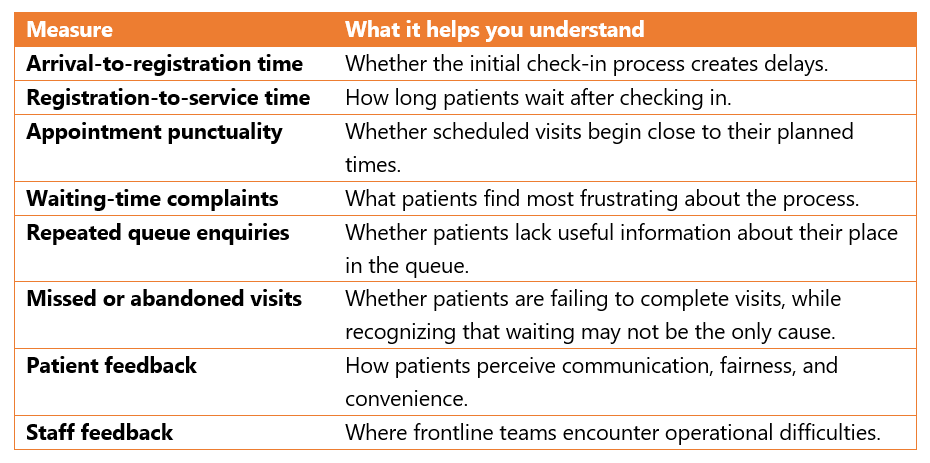 Healthcare Patient waiting-experience assessment by SmartQ
Where possible, examine these measures by department, service type, and time of day.
Be careful not to focus exclusively on average waiting times. Median waiting times, the longest waits, and the proportion of patients served within an agreed target can provide additional insight.
Also distinguish between administrative waiting and clinically necessary waiting. In healthcare, speed must never come at the expense of safe and appropriate care.
Once you understand the problem, you can determine whether process redesign, clearer communication, changes to appointment scheduling, additional staffing, technology, or a combination of approaches is appropriate.
The takeaway: Diagnose the waiting experience before choosing the solution.
For your facility, the most useful question is: Which aspects of our current waiting and appointment processes are creating avoidable uncertainty, and how can we measure improvement?
That question provides a stronger starting point than choosing a technology based on features alone.
Should Your Facility Consider a Digital Queue Management System?
After reviewing your waiting experience, you may find that some challenges can be addressed through process changes and clearer communication.
Others may require more structured coordination.
For example, if patients repeatedly approach reception for queue updates, you may need a better way to communicate their position and expected waiting time.
If appointment and walk-in processes are difficult to coordinate, you may need a more unified approach to managing both.
If patients must remain physically in line even when remote queueing would be appropriate, you may want to explore ways to give them more flexibility.
In these circumstances, a live queue and appointment management system may be worth considering.
When evaluating options, look beyond whether a product can issue digital tickets.
Ask whether it can support the workflows your facility actually uses.
Useful capabilities to assess include:
- Onsite and remote queue joining.
- Live management of physical walk-in queues.
- Integration of scheduled appointments with live queue workflows.
- Queue-position and estimated-wait information.
- Automated WhatsApp and SMS ticketing and notifications.
- Configurable emergency and priority queues.
- Multiple access options for patients with different digital needs.
- Reporting capabilities that support operational improvement, where available.
SmartQ is one option that brings together these types of queue and appointment management capabilities, with customisation intended to support different service requirements.
Whether it is suitable for your facility depends on your workflows, patient population, clinical requirements, implementation needs, and budget.
A useful waiting experience assessment should therefore begin with your challenges and show how the system would address them, not simply present a list of features.
A Practical First Step: Assess Your Patient Waiting Experience
You do not need to commit to a new system to begin improving the waiting experience.
Start by observing what happens during a typical day at your facility.
Speak to patients about what they find difficult. Ask reception staff where delays and repeated enquiries occur. Review appointment schedules and waiting-time records where available.
Then identify one or two changes that could make the process clearer or more predictable.
Perhaps patients need better information when appointments run late. Perhaps the check-in process needs to be simplified. Or perhaps your facility would benefit from exploring digital queue tracking and more coordinated appointment management.
If you would like an outside perspective, SmartQ offers healthcare decision-makers the opportunity to explore a complimentary assessment of their patient waiting experience.
The purpose is to help you examine your current process, identify potential sources of uncertainty, and consider practical improvements—including whether a digital queue and appointment management system could be useful.
You can use the findings to inform your own service-improvement plans, whether or not you ultimately decide to adopt a new technology.
Your patients' time matters. Start by understanding how they spend it.
A better waiting experience does not necessarily mean eliminating every delay.
It means helping patients understand what is happening, giving them appropriate information and choices, and making the service process easier to navigate.
If you would like to understand where your facility could improve, consider starting with a complimentary patient waiting experience assessment.
It is an opportunity to identify potential improvements, ask the right questions, and determine what your patients and frontline teams need most.
Better patient experiences begin not only with the care patients receive, but also with how thoughtfully that care is organised.
Eliminate Physical Waiting in Your Service Center
Join leading clinics, financial institutions, and service centers that have streamlined customer arrival with SmartQ virtual queuing.